Preparing for the arrival of a baby involves sorting through dozens of product categories, standards, and health recommendations. The world of childcare covers everything from sleeping arrangements to transportation, feeding, and hygiene. Each expense category does not carry the same weight in the budget nor the same impact on the newborn’s safety. This article compares priority items, details recent standards to know, and identifies the concrete trade-offs that make a difference for parents.
R129 Standard for Car Seats: What Changes for New Parents
As of September 1, 2024, car seats approved only under the old R44 standard can no longer be sold in the European Union. The R129 standard, based on the child’s size, becomes the reference for any new purchase.
R44 seats already owned by families remain usable as long as they are in good condition and comply with their original approval. However, a second-hand seat must be checked: no cracks, complete harness, readable approval label.
A point often overlooked concerns stroller carrycots. A carrycot designed for walking cannot serve as a restraint device in a car unless it has a separate approval as a car seat. Confusing the two exposes the infant to a real risk in the event of a collision. Specialized resources like babys-corner.be help identify equipment that complies with current standards before finalizing a baby registry.

Childcare Budget: Real Weight of Each Item to Prepare for Birth
Not all childcare items have the same duration of use or impact on daily life. The table below ranks the main items according to their usage duration and priority in terms of safety.
| Item | Average Usage Duration | Safety Priority | Note |
|---|---|---|---|
| Car seat (group 0+) | Up to about 12-15 months | Maximum | R129 standard mandatory for new |
| Crib and mattress | Up to 2-3 years | High | Firm mattress, no pillow or bumper |
| Stroller | Up to 3-4 years | Moderate | Check carrycot approval if used for car transport |
| Newborn clothes | Few weeks | Low | Prefer second-hand for early sizes |
| Bath / changing table | 6 to 12 months | Moderate | The stability of the support matters more than the brand |
| Feeding equipment or bottles | Variable | Low | Wait until birth to adjust quantities |
The car seat and crib concentrate the highest safety stakes. These are the two items where buying new and compliant remains the strongest recommendation.
In contrast, newborn clothes, worn for just a few weeks, represent an area where second-hand options significantly reduce expenses without compromising anything. Opt for good-condition second-hand lots for sizes 0 to 3 months.
Newborn Sleeping Arrangements: Room Sharing, Co-sleeping, and Recent Recommendations
Recent French recommendations clearly distinguish between two often-confused practices: room sharing and sharing the parental bed. Having the baby sleep in the parents’ room, in their own bed, is presented as a protective measure during the first six months. Sharing the parental bed, however, remains discouraged.
The room temperature is a measurable and often underestimated parameter. The recommended range is between 18 and 20 °C. A room thermometer is very inexpensive and provides reliable information, unlike adults’ subjective perception.
For sleeping equipment, a few simple rules apply:
- A firm mattress, perfectly fitted to the bed dimensions, with no gap between the mattress edge and the walls.
- No pillow, blanket, stuffed animal, or bumper in the infant’s sleeping space.
- A sleeping bag suitable for the season is a better alternative to a blanket for maintaining body temperature without the risk of suffocation.
Baby Registry: Necessary Items and Those That Can Wait
The temptation to buy all the equipment before the birth is strong, but some items deserve to be postponed. The feeding method (breastfeeding or bottle) is sometimes only confirmed after the first few days. Buying a complete set of bottles and a sterilizer before the birth may prove unnecessary.
The equipment that is immediately useful upon returning from the maternity ward:
- R129 approved car seat for the return trip.
- Crib with a firm mattress installed and checked.
- Some bodysuits and pajamas in newborn size, plus one size up.
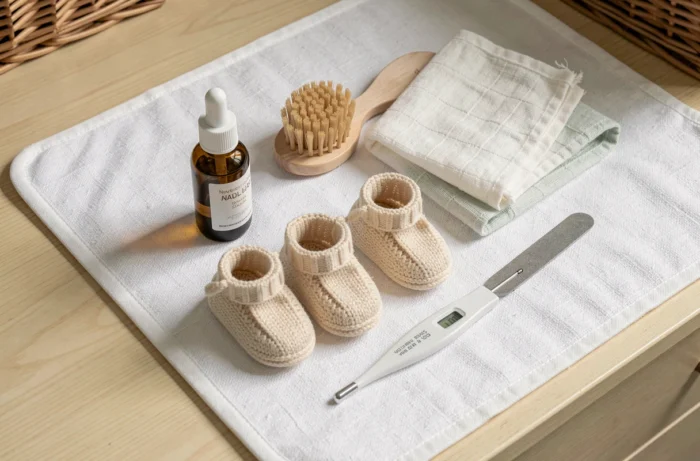
- Diapers and basic toiletry products (liniment, cotton, saline solution).
- Season-appropriate sleeping bag.
Parents creating their baby registry benefit from postponing the purchase of developmental equipment and high chairs for several weeks after birth. These items are only used from four to six months, and needs become clearer with observation of the baby.
Newborn Clothes: How Many Outfits to Prepare Without Overstock
A newborn changes outfits several times a day, but they also grow very quickly. The main risk is accumulating too many newborn clothes, worn for barely two weeks for average-sized babies.
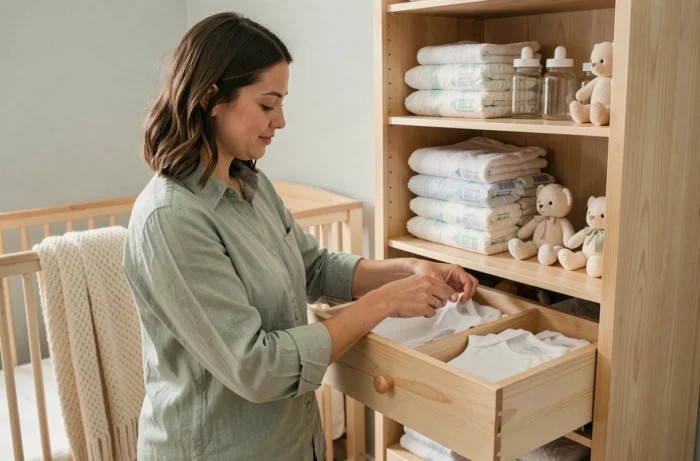
The most rational strategy is to plan a few outfits in newborn size and focus the stock on size 1 month. Five to seven bodysuits and as many pajamas cover the first days, provided laundry is done every two days. Adding a hat, socks, and a cardigan is sufficient for the hospital discharge.
For families receiving gifts, guiding friends and family towards sizes 3 or 6 months prevents overcrowding in the newborn drawer and ensures useful clothing over time.
The clothing category remains the one where the price difference between new and second-hand is most pronounced, with often negligible quality differences in items worn for just a few weeks. Birth preparations become more coherent when the budget freed up from clothing is redirected towards items with high safety requirements, such as the car seat or crib.