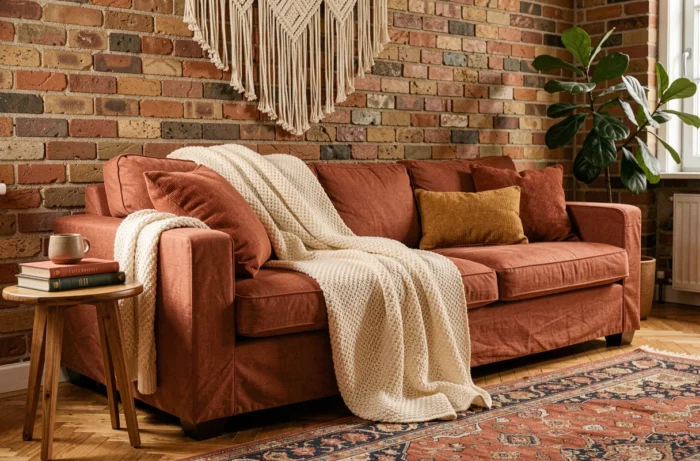
Cozy decor is no longer just about piling blankets on a sofa. Recent trends are steering interiors towards a warm minimalism that favors raw materials, textured wall finishes, and vintage furniture, moving away from the uniform accumulation of beige cushions. This evolution raises a concrete question: how to achieve an enveloping atmosphere without multiplying accessories or overcrowding the space.
Creating a cozy room without cluttering with objects
The most common reflex is to add decorative elements to gain warmth. Blankets, candles, extra cushions, wicker baskets: each addition seems to bring the room closer to a cocooning ideal. The result, often, is a cluttered space that produces the opposite effect.
The approach that is emerging in recent interiors is based on a different principle: working on surfaces and light before thinking about accessories. A textured plaster wall or hand-applied lime creates a visual depth that no cushion can replicate. The color drenching technique, which involves painting walls, woodwork, and sometimes ceilings in the same deep hue, creates a sense of architectural enveloping.
Specifically, a room treated with a lime plaster in a terracotta or sage green tone appears immediately more intimate, even when empty of furniture. The idea is not to ban textiles, but to reduce them to a few chosen pieces: a dense wool rug, a washed linen throw on the main seat. No more.
The inspirations found today on the decor on Notre Petite Maison confirm this shift towards clean yet sensorially rich interiors, where the material of the walls and floor does the work that was once entrusted to accessories.
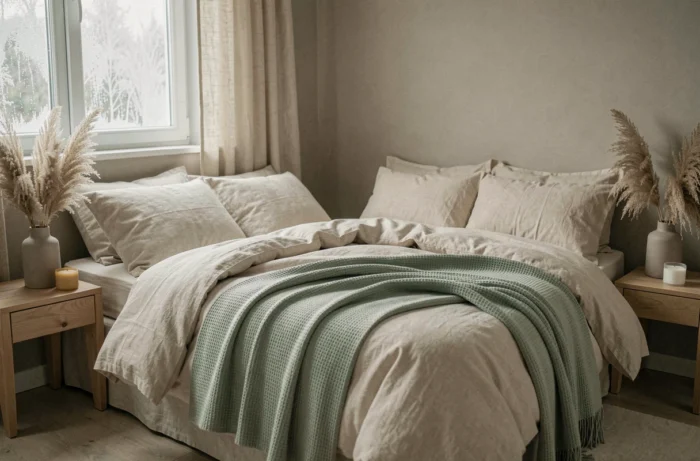
Mixing wood types and vintage furniture: warmth through imperfection
For a long time, combining multiple wood types in the same room was seen as a taste error. The unspoken rules imposed strict coherence: all light oak, or all dark walnut. This rigidity is fading.
Combining oak, walnut, and pine in the same living room is now considered a viable option, provided you stay within a range of warm and balanced tones. A dark walnut sideboard can coexist with a light oak coffee table and raw pine shelves. The contrast creates relief and gives the impression of an interior built over time, not ordered all at once.
This principle aligns with the so-called “grandmacore” trend, which rehabilitates antique furniture, retro dishware, and floral fabrics. The goal is no longer to produce a uniform cocoon but a warm and personal interior, built through the accumulation of eras. A 1950s bistro chair next to a contemporary corduroy sofa creates a cozier effect than a matching set from the same catalog.
Priority pieces to hunt for
- An accent chair with an exposed wood frame and a thick fabric (velvet, boucle cotton) seat adds character without taking up too much space
- An antique mirror with a gilded or patinated frame reflects natural light and visually enlarges the room, two functions that a new mirror performs less effectively
- A side table made of artisanal ceramic or turned wood serves as a textured focal point next to a simple-lined sofa
Lighting and colors for a lasting cocooning atmosphere
Lighting remains the most underestimated lever of cozy decor. A single ceiling light emitting white light neutralizes any attempt at a warm atmosphere, regardless of the furniture underneath. The solution lies in two rules.
The first: multiply low light sources. A lamp on a sideboard, a wall sconce directed towards the ceiling, a filament string light placed in a niche. Each light point should be below the eye level of a seated person. The ceiling remains in shadow, the walls capture the light, and the room gains intimacy.
The second: choose bulbs with a color temperature not exceeding 2,700 kelvins. Beyond that, the light leans towards cold white and breaks the desired effect. LED filament bulbs, which emit around 2,200 kelvins, produce an amber glow close to that of a candle.
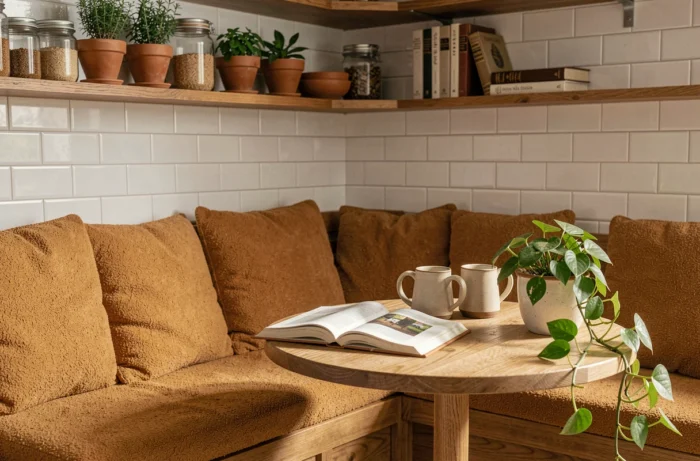
Color palette and color drenching
Cozy palettes are no longer limited to beige and off-white. Color drenching pushes the logic further: a single deep hue applied to all surfaces of a room abolishes the harsh contrasts between wall and ceiling. A deep olive green, a matte terracotta, or a midnight blue envelops the room like a monochrome cocoon.
Field reports diverge on this point. Some interior architects believe that color drenching works best in small rooms (bedrooms, offices), where the immersion effect is immediate. In a large open living room, the risk is to create a heavy atmosphere if the furniture does not break the chromatic monotony with contrasting natural materials (light rattan, white ceramic, unbleached linen).
Air quality and materials: cozy beyond aesthetics
One aspect rarely addressed in decor guides concerns the composition of the materials used. Scented candles, cheap decorative paints, and certain synthetic textiles emit volatile organic compounds that degrade indoor air quality.
Opting for low-emission materials (A+ labeled paints, plant-based waxes, untreated natural fiber textiles) allows for a balance between visual comfort and a healthy environment. A soy wax candle without synthetic fragrance, a lime wall coating that naturally regulates humidity, a rug made of unbleached virgin wool: these choices may not be visible, but they change the quality of the air breathed every day in the room.
- Check the emission class (A+) on paint cans and decorative coatings
- Prefer organic cotton, linen, or wool for textiles in prolonged contact (cushion covers, throws, curtains)
- Replace industrial scented candles with versions made from plant wax with cotton wicks
The most successful cozy decor is probably the one that doesn’t catch the eye at first glance. Walls with texture, wood that shows signs of use, light that falls just right, and air that we breathe without thinking.