
The first mornings at daycare or nursery are challenging for both parents and children. Your little one will discover a new place, new faces, and new sounds. Meanwhile, you will be dealing with a separation that can sometimes be more difficult than expected. Understanding what is happening during this transition helps to navigate it with more calmness.
Individualized Welcome Project: A Health Framework Often Unknown in Daycare
You may have noticed that discussions among parents often revolve around separation cries or the choice of a comfort item? However, one topic often flies under the radar: the management of allergies and health issues in a group setting.
If your child has a food allergy, intolerance, or chronic condition, the facility can implement an individualized welcome project (PAI). This document, established based on a medical prescription, formalizes the precautions to be taken on a daily basis: adapted meals, medications to be administered, emergency procedures. The circular of February 10, 2021, regulates this system for daycares, temporary childcare centers, and kindergartens.
In practice, the PAI is developed with the family and the facility’s team. You will find parent information on Douceur Enfance that details this type of process. The idea is not to create an administrative burden, but to establish a clear framework so that your child is welcomed safely.
The DGCS also reminds us of the role of the health and inclusive welcome referent, present in the facilities, who ensures the conditions for administering medications and the vaccination obligation. Check these points during your first meeting with the management.
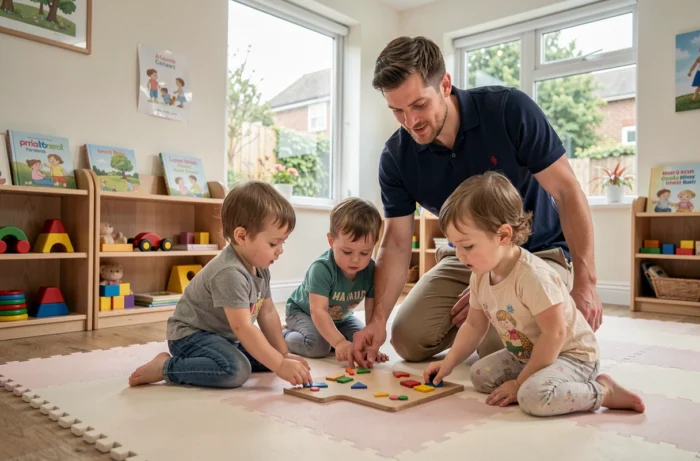
Adaptation in Daycare: What Really Happens in the First Week
The adaptation period generally lasts from a few days to two weeks. Its principle is simple: gradually increase the time spent by the child in the facility, first in your presence and then without you.
Why This Gradual Approach Matters
A child of a few months does not perceive time like an adult. When you leave the room, they do not yet know that you will return. Each return builds their trust. It is a concrete learning experience, not a whim.
Separation cries are a normal reaction, not a sign of failure. They reflect a healthy attachment. Most children calm down within minutes after the parent leaves, once engaged by an activity or a designated professional.
The Role of the Designated Professional
In many facilities, an adult is designated as your child’s referent during the adaptation period. This professional becomes a stable point of reference in a new environment. They observe reactions, note habits (sleep, eating, favorite games), and connect with you at the end of the day.
This approach is not trivial. The referent reduces the child’s stress by providing a reliable secondary attachment figure.
Supervision in Micro-Crèches: The Rules Have Changed
If you have chosen a micro-crèche, be aware that regulations have recently evolved. Decree No. 2025-304 of April 1, 2025, gradually aligns the supervision standards of micro-crèches with those of traditional facilities.
Why this change? Recurring criticisms pointed out quality discrepancies between micro-crèches and collective daycares, particularly regarding supervision ratios. Some transitional provisions still apply, with extensions considered until August 31, 2027.
In practice, ask these questions during your visit:
- How many adults supervise the children at all times of the day, including during meals and nap time?
- What is the educational project of the facility and how is it implemented daily?
- How does the facility handle medical emergencies and the welcome of children with a PAI?
These questions help distinguish between commercial discourse and actual organization.

Morning and Evening Rituals: Building Lasting References
A child finds reassurance in repetition. The morning separation ritual does not need to be elaborate. It should be short, predictable, and the same every day.
A concrete example: you drop off the bag, help your child take off their coat, say goodbye with the same phrase, and then leave. Leaving without hesitation sends a clear signal: everything is fine. Back-and-forths (“just one last hug”) prolong the separation and increase anxiety.
In the evening, the reunion ritual is equally important. Take a few minutes to listen to the professional’s report. Ask how the meal went, the nap, and interactions with other children. These details reconnect you to your child’s day and show the team that you are involved.
- Choose a transitional object (comfort item, fabric with your scent) approved by the facility, which accompanies your child throughout the day.
- Keep the same drop-off and pick-up times as much as possible during the first weeks.
- Avoid changing multiple habits at once (weaning, moving, changing caregivers) during the adaptation phase.
The consistency of the first days determines the trust that the child places in the place. Once this trust is established, mornings become smoother, sometimes in a few weeks, sometimes taking a bit longer. Each child has their own pace, and this pace deserves to be respected by both parents and professionals.