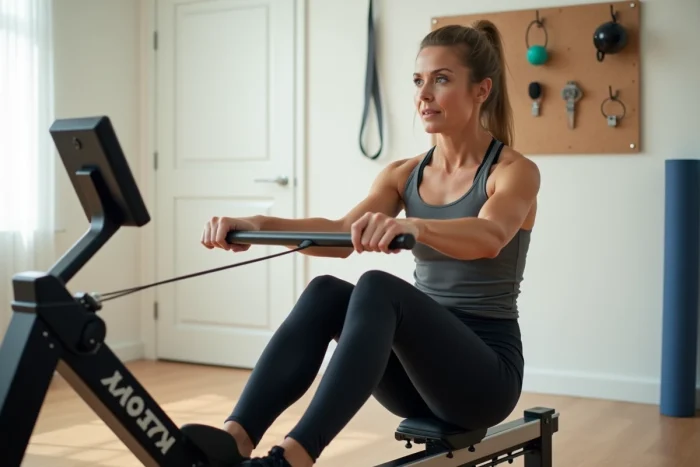
Are you looking for a rowing machine for your home gym, but the Marcy brand offers several models with very different profiles? Compact foldable rower after the session, HIIT-oriented machine with progressive resistance, device designed for heavier users: each model targets a specific use. Understanding these differences before purchasing prevents you from ending up with a device that is too limited or oversized for your fitness goals.
Resistance and pull: what really changes from one Marcy rower to another
Before looking at the price or design, focus on the resistance system. It determines the rowing feel, the progression of effort, and the type of training possible.
A Marcy rower with magnetic resistance offers a quiet and smooth movement. The braking is adjustable in increments, which is suitable for regular cardio sessions at moderate intensity. However, the progression remains limited: beyond a certain level, the resistance caps out.
The air resistance model, like the Marcy Turbine Rower, works differently. The resistance increases with the power of your pull: the harder you row, the more the effort increases. This mechanism is ideal for interval training like HIIT, where you alternate explosive phases and recovery times.
Why does this choice matter so much? Because a weight training practitioner used to heavy loads will not have the same expectations as someone returning to activity. Marcy positions several of its rowers based on a logic of lightweight strength combined with cardio, with resistance levels higher than the average entry-level devices. If you already train with a rack or dumbbells, this heavier pull complements a muscle strengthening program well.
To choose a suitable Marcy rower, first identify whether your priority is gentle cardio, intense intervals, or a complement to your weight training.

Weight capacity and size: an underestimated criterion for Marcy rowers
Most rowing machine buying guides mention resistance and the screen, then move on to price. The maximum weight supported by the device is rarely highlighted. Yet, it is a determining filter, especially with Marcy.
Some Marcy models accept users up to 135 or 140 kg, whereas many competing compact rowers are limited to 110 or 120 kg. This additional margin is not only relevant for overweight individuals.
- A tall user (over 1.85 m) often weighs more, and an undersized device wears out faster at the rail and bearings.
- A weight training practitioner with a high body weight in muscle mass easily exceeds the lower limits of entry-level rowers.
- The load capacity also affects the overall stability of the machine during powerful pulls: a frame designed for 140 kg vibrates less than a frame limited to 110 kg, even if you weigh 80 kg.
Check this data on the technical sheet of the targeted model. A stable rower during each pull protects your joints and makes the session more comfortable over time.
Foldable or fixed Marcy rower: available space and frequency of use
Have you noticed that an unfolded rower easily occupies two meters of floor space? In an apartment or a shared home gym room, the bulk quickly becomes a problem.
The Marcy NS-6002RE addresses this constraint with a vertical foldable structure and transport wheels. After the session, the device can be stored against a wall or in a closet. This format is suitable for training three to four sessions per week at moderate intensity.
A fixed rower, heavier and longer, offers in return a more stable glide rail and a wider pulling stroke. If you have a dedicated space (garage, workout room), the fixed model remains the best choice for daily sessions or intense intervals.
How to decide between the two formats
- Measure the available floor space once the rower is unfolded, then the storage space once folded.
- Evaluate your training frequency: folding and unfolding a device at each session can become discouraging if you row every day.
- Consider the weight of the device itself: a lightweight foldable rower is easy to move, but a model that is too light may lack stability during effort.
Screen and training tracking on Marcy rowers
Most Marcy rowers come with a basic LCD screen displaying time, distance, number of strokes, and estimated calories. For fitness or regular cardio use, this data is sufficient to track your progress from one session to the next.
Do not expect Bluetooth connectivity or compatibility with coaching apps on entry-level and mid-range models. If connected tracking is a priority for you, check the product sheet of the exact model before purchasing.
The screen remains a secondary criterion compared to resistance and load capacity. A rower with a sophisticated screen but unsuitable resistance for your level will not serve you for long. Focus your budget on the pulling mechanism and the sturdiness of the frame, then consider the screen as a bonus.
The choice of a Marcy rower comes down to three concrete filters: the type of resistance suitable for your training style, the weight capacity that matches your size, and the bulk compatible with your space. A device well-targeted on these three points will last longer than a model chosen randomly based on price.