A newborn can recognize their mother’s voice just a few hours after birth, but their sleep pattern remains unpredictable for several weeks. Some babies sleep for twelve hours straight by four months, while others wake up multiple times during the night until they are one year old, with no medical anomalies detected.
Motor skills do not follow a universal order: one child may roll over before sitting up, while another masters grasping well before crawling. However, professionals agree on the importance of adapting the environment and interactions at each stage to support harmonious development.
Understanding the major milestones of baby development during the first year
Observing a toddler in their first months is witnessing a flurry of discoveries, each emerging at its own pace. Initially, sensory development stands out: the infant identifies faces, calms to a voice, and snuggles during skin-to-skin contact. The senses of touch, hearing, and smell become their tools for exploration. Around three to four months, movements become more refined: fine motor skills begin to take shape, the hand grasps an object, the mouth explores, and the gaze closely follows what moves around them. Gradually, gross motor skills progress: first rollovers, attempts to crawl, and then the child sits up without support.
It is impossible to impose a single trajectory: each baby progresses at their own pace, as highlighted by Emmi Pikler. Allowing the child to experiment, fall, and try again offers them the space they need to forge their autonomy. Free movement reduces frustrations, builds confidence, and encourages curiosity. Little by little, the child refines their coordination, increases interactions, and opens up to others with a smile or an exchange of glances.
Between six and twelve months, a milestone is reached. Interactions become richer: babbling, imitative gestures, and first spatial references. Intellectual development expands through play, first words, and manipulation of objects. The attentive presence of parents, without trying to rush things, creates a fertile ground for flourishing.
For those wishing to delve deeper into these stages, learning more about Vive Mon Bébé provides insights into respectful developmental practices and the variety of profiles. Understanding the subtleties of needs and deciphering signals builds a strong bond and prepares for confident autonomy.
What awakening activities to prioritize at each age to stimulate curiosity and motor skills?
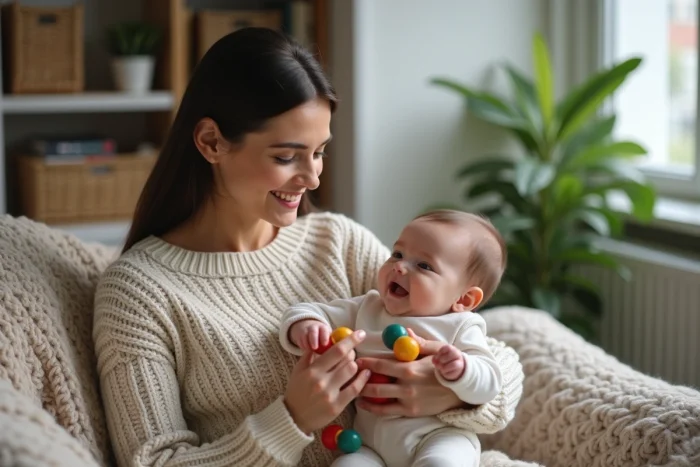
The very first moments open the door to exploring the world, driven by sight and sound. Encourage sensory play: mobiles with simple shapes, fabrics with varied textures, lightweight rattles. Talking, singing, describing what you are doing: the voice reassures, stimulates perception, and lays the groundwork for language. Setting up a play mat on the floor provides a special space to move, roll, and experiment with gross motor skills without constraints.
From three months onward, opportunities to stimulate motor skills multiply. Here are some ideas to adapt according to your child’s development:
- Allow them to roll from back to tummy and vice versa
- Offer various objects to grasp, with diverse textures
- Provide soft rings that are easy to manipulate
In front of a mirror, the child discovers themselves: a game that nourishes their curiosity and helps them orient themselves in their own movements. Fabric books, sturdy and colorful, accompany the first precise gestures while opening a window to the imagination.
Between six and twelve months, fine motor skills gain prominence. Stacking cubes, shape sorters, and nesting cups become tools for developing dexterity and coordination. Water play, especially during bath time, offers an endless source of experiences: filling, emptying, transferring. Taking the time to encourage each attempt, to accompany with words and gaze, strengthens confidence and supports the establishment of autonomy.
To guide your choices, here are the most suitable activities by age:
- 0-3 months: visual mobile, nursery rhymes, play mat
- 3-6 months: rattles, mirror, fabric books
- 6-12 months: cubes, shape sorters, water play
Offering a varied palette of activities, without overwhelming the child with objects, stimulates their desire to learn and helps them explore their abilities at their own pace.
Concrete tips to encourage autonomy, well-being, and daily care
To support each stage of awakening, regular organization of daily life makes a difference. Routines provide reference points, reassure, and facilitate transitions between activity and rest periods. Bath time, meals, bedtime: these are moments to establish familiar gestures that secure the child.
Creating a conducive environment is not a matter of chance. A clean, safe space where the child can move freely promotes free movement. A mat on the floor, a few well-chosen toys placed within reach encourage autonomy while leaving room for imagination. Allowing the child to explore, observe, touch, and sometimes fall enables them to learn to get back up and trust themselves.
Here are some ideas to support autonomy and well-being in daily life:
- Consider the child’s rhythm: observe their reactions, adapt activities according to their fatigue or desire to explore.
- Involve the child in care: offer them a wipe during diaper changes, invite them to handle their spoon, show them how to fill a small basin for bath time.
- Prioritize direct contact: carrying, massages, exchanges of glances and words. These simple gestures forge emotional and physical security, which is the true foundation of well-being.
Ensuring safety does not mean restricting exploration. Installing a barrier at the stairs, choosing appropriate objects, and observing discreetly: vigilance is exercised without stifling discovery. Talking to the child, even when they are very young, accompanies each gesture, anticipates transitions, and builds the feeling of being fully welcomed into family life.
For a baby, growing means exploring, falling, getting back up, and feeling that every step counts. At each stage, attentive support shapes a solid and joyful freedom, the kind that inspires them to dare to explore the world tomorrow.