
When considering expansion work, it is essential to prepare meticulously to avoid unpleasant surprises. Whether it is to add an extra room, enlarge the kitchen, or convert the attic, several aspects must be taken into account to successfully carry out the project.
It is important to inquire about local regulations and obtain the necessary permits before starting the work. It is advisable to hire qualified professionals to ensure the quality of the work and comply with current standards. A good plan and rigorous budget management are also essential to avoid cost overruns and meet deadlines.
The administrative steps for a home expansion
When it comes to expanding your home, the administrative steps are an unavoidable stage. Several formalities must be respected depending on the nature and size of the planned work.
Building permit or work declaration?
For home extensions creating a floor area greater than 20 m², a building permit is required. This procedure also applies if the total area of the house after the work exceeds 150 m². However, for more modest extensions, between 5 m² and 20 m², a work declaration is sufficient.
Compliance with local regulations
Each expansion project must comply with the Local Urban Plan (PLU). This document sets the applicable urban planning rules for a municipality, including maximum heights, distances to be respected from property boundaries, and permitted materials. It is necessary to consult the PLU before submitting a file.
Architect’s intervention
The intervention of an architect is mandatory if the total area after the work exceeds 150 m². Similarly, for classified buildings or those located in a protected architectural heritage area, the opinion of an architect from the French Buildings Department is required.
For a detailed view of the specific steps for a 30 m² extension, consult déclarationexpertise.fr. You will find all the information to navigate smoothly through the administrative maze of your expansion project. 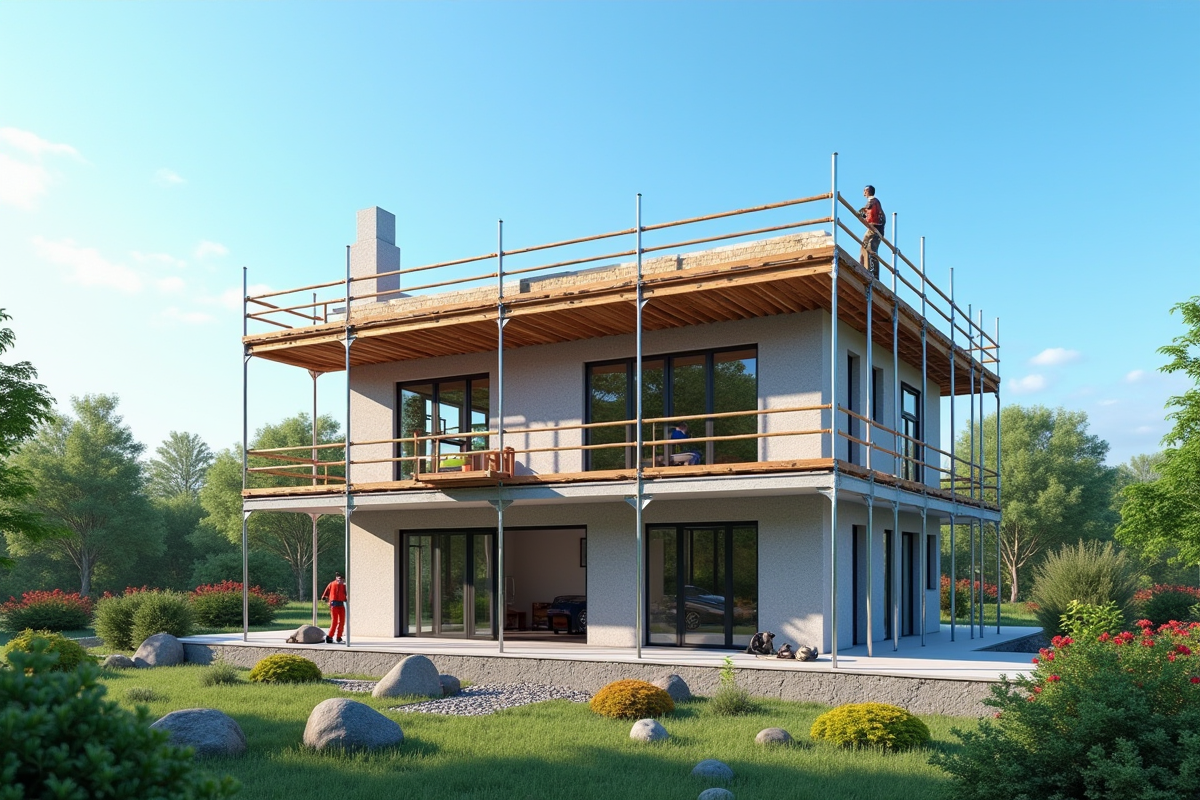
The technical and financial aspects to consider before starting
Extension options and technical constraints
Before embarking on an expansion project, it is important to consider the various options available to extend your home. The alternatives include:
- Roof elevation: adding an additional floor.
- Attic conversion: transforming an unused attic into a living space.
- Creation of an additional ground-level room: building an extension at the same level as the existing house.
- Conservatory: adding a glass room, often used as a living room or winter garden.
Each option must comply with the Ground Footprint Coefficient (CES) and the Floor Area defined by the PLU. Without this, the project could be rejected by the competent authorities.
Cost estimation and financial planning
The cost of an expansion project depends on many factors, including the size of the extension and the materials used. Here are some elements to consider when estimating the budget:
- Preliminary studies: technical diagnostics, soil studies, etc.
- Structural work: foundations, walls, roofing.
- Finishes: flooring, painting, electrical and plumbing installation.
- Fees: architect, engineering firm, craftsmen.
For a more accurate estimate, consult professionals and request multiple quotes. Don’t forget to include a margin for unforeseen expenses, often recommended at 10 to 15% of the total budget.
For more information on the cost of a home extension and practical advice, visit www.experts-immobilier.fr. You will find useful resources to effectively plan your expansion project.