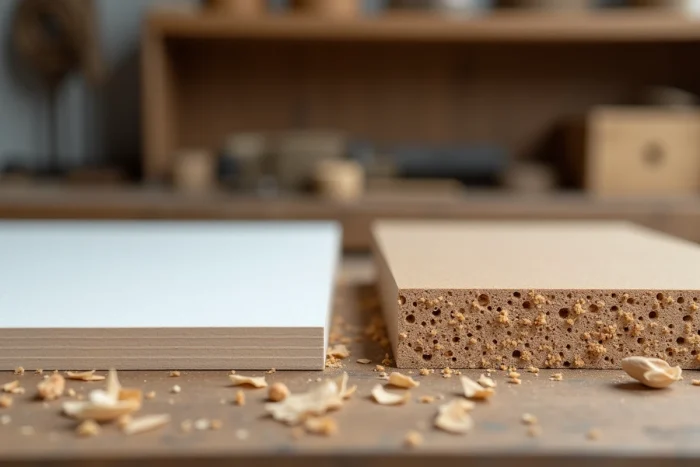
Melamine is not a material in its own right: it is a particle board (or MDF) covered with a decorative paper sheet impregnated with melamine-formaldehyde resin, hot-pressed. Particle board, on the other hand, refers to raw wood particle panels, without surface coating. Confusing the two is akin to confusing a substrate and its finish.
Copper resin and antibacterial melamine: an underappreciated use in collective kitchens
Since the health crisis, collective kitchens (school cafeterias, hospital catering) have been looking for surfaces that are easy to disinfect. Classic melamine withstands common household products well, but its smooth surface has no biocidal properties.
Manufacturers have developed melamine panels with copper resin, where copper ions are integrated directly into the resin layer during pressing. Copper acts as a contact antibacterial agent, reducing microbial proliferation between cleanings. This type of panel targets countertops, wall coverings, and storage in collective kitchens.
To delve deeper into the difference between melamine and particle board on Bricotronique, the principle remains the same: the particle board serves as a substrate, and the copper resin simply replaces the standard resin on the surface. Raw particle board, without this coating, has no antibacterial properties.

Composition of particle board: what lies beneath the decor
Particle board is made from wood chips and particles, bonded with a formaldehyde-based glue and then compressed at high temperature. The result is a homogeneous, dense panel, but porous on the surface.
The quality of a panel depends on several factors:
- The particle size: fine particles on the surface and coarser ones in the center improve the rigidity and flatness of the panel.
- The type of glue: urea-formaldehyde glues are common, but water-resistant versions (classified P3) use melamine-urea-formaldehyde resins to resist swelling in humid environments.
- The emission classification: since January 2026, regulation (EU) 2025/2345 imposes stricter tests on formaldehyde emissions (enhanced E1 class) for all melamine particle boards sold in the European Union.
A raw particle board panel, without surface treatment, absorbs water quickly through its edges and face. This is its main limitation.
Melamine and moisture resistance: the concrete limits of the coating
The melamine coating protects the face of the panel against stains, light scratches, and surface moisture. The thermosetting resin forms a waterproof barrier under normal usage conditions (wiped countertop, ventilated bathroom shelf).
The edges remain the weak point of melamine. During a custom cut, the particle board panel becomes exposed. A UFC-Que Choisir study published in March 2026 reports that a quarter of the professionals surveyed notice frequent chipping on melamine edges in humid environments. The recommendation: use reinforced PVC edge bands instead of standard melamine iron-on edges.
Water-resistant melamine classified P3 offers significantly better swelling resistance than standard MDF, according to the CTBA technical bulletin from February 2026. In return, this P3 panel is less suitable for complex assemblies (grooves, fine rebates) because its irregular density complicates precise machining.
Raw particle board or melamine: choose according to the project
The choice between raw particle board and melamine does not arise in the same terms depending on the intended use.
Furniture boxes and interior storage
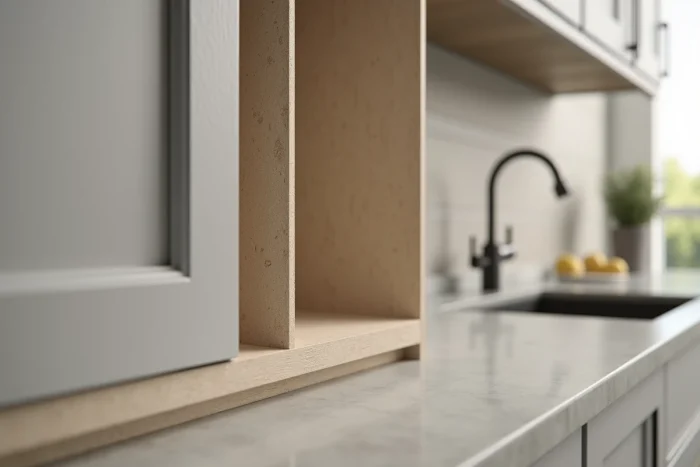
White or wood-decor melamine remains the standard for kitchen boxes, cabinet bodies, and bookshelves. Its surface requires neither paint nor varnish, which reduces manufacturing time and finishing costs. A raw particle board used for the same purpose would require an additional painting or veneering step.
Supports intended to be veneered or painted
Raw particle board finds its place when the final surface will be covered: installation of high-pressure laminate (HPL), real wood veneer, or paint. In this case, paying the extra cost for melamine coating adds no value since the decorative layer will be masked.
Wet areas and countertops
A P3 melamine with PVC edges is suitable for under-sink furniture and secondary countertops. For a main countertop subjected to frequent water splashes, HPL laminated onto water-resistant particle board offers more durable protection than simple melamine, whose resin thickness remains thin.
Formaldehyde emissions and regulatory compliance
The resin that binds the wood particles in particle board, like that which forms the melamine coating, contains formaldehyde. This volatile organic compound is gradually emitted after manufacturing.
The European regulation that came into effect in January 2026 strengthens the E1 class thresholds for melamine particle boards. In practice, imports of non-compliant panels from Asia have decreased since the implementation of this regulation. Checking for the “E1” label (or “E0.5” when it exists) on the labeling remains the reflex to adopt when purchasing.
PEFC or FSC certified panels guarantee the sustainable origin of the wood used, with no direct link to the level of formaldehyde emissions. The two pieces of information are complementary, not interchangeable.
Melamine and particle board share the same skeleton of wood particles. The only difference lies in the surface layer, its thickness, and its composition. Choosing one or the other without considering exposure to moisture, the desired finish type, and the regulatory compliance of the panel is to ignore the three criteria that determine the lifespan of the furniture.